

Health Library
Simple goiter
Goiter - simple; Endemic goiter; Colloidal goiter; Nontoxic goiter
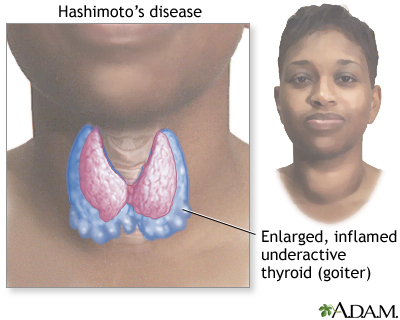
A simple goiter is an enlargement of the thyroid gland. It is usually not a tumor or cancer.
Images
I Would Like to Learn About:
Causes
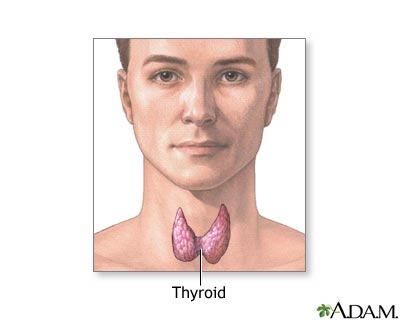
The thyroid gland is an important organ of the endocrine system. It is located at the front of the neck just above where your collarbones meet. This gland makes and releases the hormones thyroxine (T4) and triiodothyronine (T3), which control body metabolism. Controlling metabolism is important for regulating mood, weight, and mental and physical energy levels.
Iodine deficiency is the most common cause of a goiter. The body needs iodine to produce thyroid hormone. If you do not have enough iodine in your diet, the thyroid gets larger to try and capture all the iodine it can, so it can make the right amount of thyroid hormone. So, a goiter can be a sign the thyroid is not able to make enough thyroid hormone. The use of iodized salt in the United States prevents a lack of iodine in the diet for people who use it.
Other causes of a goiter include:
- The body's immune system attacking the thyroid gland (autoimmune problem)
- Certain medicines (lithium, amiodarone)
- Infections (rare)
- Cigarette smoking
- Eating very large amounts of certain foods (soy, peanuts, or vegetables in the broccoli and cabbage family)
- A toxic nodular goiter, an enlarged thyroid gland that has a small growth or many growths called nodules, which produce too much thyroid hormone
Simple goiters are more common in:
- People over age 40
- People with a family history of goiters
- People who are born and raised in areas with iodine deficiency
- Women
Symptoms
The main symptom is an enlarged thyroid gland. The size may range from a single small nodule to a large mass at the front of the neck.
Some people with a simple goiter may have symptoms of an underactive thyroid gland.
In rare cases, an enlarged thyroid can put pressure on the windpipe (trachea) and food tube (esophagus). This can lead to:
- Breathing difficulties (with very large goiters), especially when lying flat on the back or when reaching up with your arms
- Cough
- Hoarseness
- Swallowing difficulties, especially with solid food
- Pain in the area of the thyroid
Exams and Tests
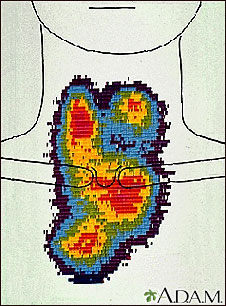
Your health care provider will do a physical exam. This involves feeling your neck as you swallow. Swelling in the area of the thyroid may be felt.
If you have a very large goiter, you may have pressure on your neck veins. As a result, when your provider asks you to raise your arms above your head, you may feel dizzy.
Blood tests may be ordered to measure thyroid function:
Tests to look for abnormal and possibly cancerous areas in the thyroid gland include:
If nodules are found on an ultrasound, a biopsy may be needed to check for thyroid cancer.
Treatment
A goiter only needs to be treated if it is causing symptoms.
Treatments for an enlarged thyroid include:
- Thyroid hormone replacement pills if the goiter is due to an underactive thyroid
- Small doses of Lugol's iodine or potassium iodine solution if the goiter is due to a lack of iodine
- Radioactive iodine to shrink the gland if the thyroid is producing too much thyroid hormone
- Surgery (thyroidectomy) to remove all or part of the gland
Outlook (Prognosis)
A simple goiter may disappear on its own, or may become larger. Over time, the thyroid gland may stop making enough thyroid hormone. This condition is called hypothyroidism.
In some cases, a goiter becomes toxic and produces thyroid hormone on its own. This can cause high levels of thyroid hormone, a condition called hyperthyroidism.
When to Contact a Medical Professional
Contact your provider if you experience any swelling in the front of your neck or any other symptoms of a goiter.
Prevention
Using iodized table salt prevents most simple goiters.
Related Information
CancerMalignancy
Toxic nodular goiter
Thyroid gland removal - discharge
References
Alexander EK, Haymart MR, Pattison DA, Wirth LJ, Zeiger MA. Nontoxic diffuse goiter, nodular thyroid disorders, and thyroid malignancies. In: Melmed S, Auchus RJ, Goldfine AB, Rosen CJ, Kopp PA, eds. Williams Textbook of Endocrinology. 15th ed. Philadelphia, PA: Elsevier; 2025:chap 12.
Paschke R, Eszlinger M, Kopp P. Euthyroid and hyperthyroid nodules and goiter. In: Robertson RP, ed. DeGroot's Endocrinology. 8th ed. Philadelphia, PA: Elsevier; 2023:chap 77.
Pearce EN, Hollenberg AN. Thyroid. In: Goldman L, Cooney KA, eds. Goldman-Cecil Medicine. 27th ed. Philadelphia, PA: Elsevier; 2024:chap 207.
Smith JR, Wassner AJ. Goiter. In: Kliegman RM, St. Geme JW, Blum NJ, et al, eds. Nelson Textbook of Pediatrics. 22nd ed. Philadelphia, PA: Elsevier; 2025:chap 605.
Ullmann T, Kim J, Lindeman B, Sosa JA. The thyroid. In: Tyler DS, Hayes-Dixon A, Hines OJ, et al, eds. Sabiston Textbook of Surgery. 22nd ed. Philadelphia, PA: Elsevier; 2026:chap 73.
BACK TO TOPReview Date: 1/25/2026
Reviewed By: Sandeep K. Dhaliwal, MD, board-certified in Diabetes, Endocrinology, and Metabolism, Springfield, VA. Also reviewed by David C. Dugdale, MD, Medical Director, Brenda Conaway, Editorial Director, and the A.D.A.M. Editorial team.
 | A.D.A.M., Inc. is accredited by URAC, for Health Content Provider (www.urac.org). URAC's accreditation program is an independent audit to verify that A.D.A.M. follows rigorous standards of quality and accountability. A.D.A.M. is among the first to achieve this important distinction for online health information and services. Learn more about A.D.A.M.'s editorial policy, editorial process and privacy policy. A.D.A.M. is also a founding member of Hi-Ethics. This site complies with the HONcode standard for trustworthy health information: verify here. |
The information provided herein should not be used during any medical emergency or for the diagnosis or treatment of any medical condition. A licensed medical professional should be consulted for diagnosis and treatment of any and all medical conditions. Links to other sites are provided for information only -- they do not constitute endorsements of those other sites. No warranty of any kind, either expressed or implied, is made as to the accuracy, reliability, timeliness, or correctness of any translations made by a third-party service of the information provided herein into any other language.
© 1997-
2026 A.D.A.M., a business unit of Ebix, Inc. Any duplication or distribution of the information contained herein is strictly prohibited.
All content on this site including text, images, graphics, audio, video, data, metadata, and compilations is protected by copyright and other intellectual property laws. You may view the content for personal, noncommercial use. Any other use requires prior written consent from Ebix. You may not copy, reproduce, distribute, transmit, display, publish, reverse-engineer, adapt, modify, store beyond ordinary browser caching, index, mine, scrape, or create derivative works from this content. You may not use automated tools to access or extract content, including to create embeddings, vectors, datasets, or indexes for retrieval systems. Use of any content for training, fine-tuning, calibrating, testing, evaluating, or improving AI systems of any kind is prohibited without express written consent. This includes large language models, machine learning models, neural networks, generative systems, retrieval-augmented systems, and any software that ingests content to produce outputs. Any unauthorized use of the content including AI-related use is a violation of our rights and may result in legal action, damages, and statutory penalties to the fullest extent permitted by law. Ebix reserves the right to enforce its rights through legal, technological, and contractual measures.
